Lightwell Institute for Open ScienceResearch & Computational Systems ArchiveORCID: 0009-0002-8487-759XGitHub: @Michaelrobins938

Scientific Systems &
Formal Research Archive

Principal Investigator: Dr. Michael Forsythe Robinson

Laboratory Abstract

The Lightwell Science Institute develops formal algebraic systems, causal intermediate representations, and continuous safety telemetry for cross-domain knowledge representation and autonomous reasoning. This archive collects our peer-reviewed publications, preprints, open-source computational systems, and corpus datasets.

Utriusque Cosmi Macrocosmi et Microcosmi Archiva

Epistemic Architecture & Cosmic System Map

Historical macrocosmic astrolabe vector mapping Dr. Michael Forsythe Robinson’s formal research domains.

FIG. 1.0 — ROBERT FLUDD (1617) ADAPTATION
MACROCOSMUS · SPHAERA INTELLECTUALIS · INTEGRITASMICROCOSMUS · CAUSALIS EPISTEMIA · HARMONIAΩ1SPHAERA PHYSIOLOGICA2MACROCOSMUS BIOMETEOROLOGICUS3SPHAERA INTELLECTUALIS4HARMONIA ELEMENTARIS5LOGICA ARISTOTELICA-GALILEANA6CORPUS ARCHIVUM UNIVERSE
CLICK ORBITAL NODES (1-6) TO INSPECT FORMALISMS
SPHAERA PHYSIOLOGICANODE 01 / 06

FEP Metabolic Screening Protocol

Free Energy Principle framework for CGM telemetry, identifying metabolic state transitions with 10-day glucose continuous monitoring.

Theoretical Formalism (LaTeX)Archival Record
\[ Z_{lag} = \frac{\Delta \text{CGM}_{t+10} - \mu}{\sigma} > 2.58 \]
Validation Metrics & SLA
No compliance SLA claimed · p < 0.001
Section 1.0

Publications & OSF Preprints

5 Peer-Reviewed & Pre-print Papers
Robinson, M. F. (2026)Frontiers in Psychiatry / OSF Preprints

A reversible metabolic and endocrine subset in first-presentation psychosis: a testable hypothesis and screening protocol

OSF Preprint id: fep-metabolic-v0.9

A measurable minority of patients presenting for first-episode psychosis carry an identifiable metabolic or endocrine condition driving the psychotic syndrome rather than co-occurring with it. Antipsychotic-naïve patients exhibit elevated insulin resistance (HOMA-IR Hedges' g = 0.35) and impaired glucose tolerance (post-OGTT glucose g = 0.61) at psychiatric onset, while HbA1c is unaltered (g = −0.08; Pillinger et al., 2017) — the standard screening test misses episodic hypoglycemia and subclinical insulinoma drivers. We propose a prospective 1,250-patient multi-center screening trial combining continuous glucose monitoring (CGM), temporal-concordance lag analysis, and cause-directed treatment protocols.

First-Episode PsychosisContinuous Glucose MonitoringSecondary PsychosisMetabolic PsychiatryFalsifiable Protocol
Robinson, M. F. (2026)Environmental Health & Geophysical Research

Geomagnetic Activity and Cardiovascular Mortality: A 21-Year U.S. Time-Series Analysis with Nocturnal Interaction Effects

21-Year CDC NVSS Cohort Analysis (2000–2020)

We analyzed monthly U.S. mortality data from 2000 to 2020 (CDC NVSS) to evaluate the relationship between planetary Kp index geomagnetic activity and cardiovascular mortality. Using Poisson regression with HC3 robust standard errors, month fixed effects, secular trend, and temperature adjustment, we found higher geomagnetic activity was positively associated with SUNDS proxy mortality (beta = 0.3152, p = 0.0139) and broad cardiac mortality (beta = 0.3124, p = 0.0123). The strongest structural finding was a positive interaction between geomagnetic activity and nocturnal exposure (beta = 0.5538, p = 0.0113), indicating state-dependent nocturnal vulnerability.

GeomagnetismCardiovascular MortalityKp IndexPoisson RegressionNocturnal Interaction
Robinson, M. F. (2026)Journal of Formal Artificial Intelligence & System Architecture

The 3-6-9 Epistemic Architecture & Epistemic Operating System (Epistemic OS)

vol. 3, no. 1, pp. 12–39

Formulates the 3-6-9 Epistemic Operating System architecture representing triadic state verification, hexadic causal validation, and nonavoid inference structures. Implements continuous state integrity bounds and Model Revision Calculus across autonomous multi-agent reasoning networks.

Epistemic OS3-6-9 ArchitectureModel Revision CalculusState Verification
Robinson, M. F. (2025)Atmospheric Electrodynamics & Geophysical Phenomena

The Butterfly People of Joplin: A Plasma Hypothesis and High-Frequency Electrodynamics Analysis

Monograph Series in Plasma-Void Dynamics

Investigates severe convective storm plasma ionization phenomena, luminous boundary discharge artifacts, and bio-electromagnetic sensory reports associated with the 2011 Joplin EF5 tornado event. Formulates boundary condition equations for high-intensity localized electromagnetic void coupling.

Plasma PhysicsJoplin TornadoElectrodynamicsAtmospheric Physics
Robinson, M. F. (2025)Zenodo Open Science Repository

A First-Principles Hybrid Causal Attribution Framework for High-Dimensional Datasets

Monograph id: 18557680

Combines structural causal models (SCM), Shapley causal values, and counterfactual uplift estimators for high-dimensional time-series data with zero unobserved confounding assumptions.

Causal AttributionStructural Causal ModelsShapley ValuesCounterfactuals
Section 2.0

Open Source Systems & Live Web Applications

GitHub: @Michaelrobins938
FEP Metabolic Screening Framework & Protocol
EXHIBIT 01
OSF Preprint · Published
ProtocolContinuous Glucose Monitoring & Secondary Psychosis Screening

FEP Metabolic Screening Framework & Protocol

Prospective screening trial protocol identifying treatable metabolic/endocrine subsets in antipsychotic-naïve first-episode psychosis. Combines 10-day CGM continuous telemetry, temporal lag-concordance analysis, and cause-directed treatment arms (N=1,250 cohort).

First-Episode PsychosisCGM TelemetryMetabolic PsychiatryFalsifiable Protocol
Cohort SizeN = 1,250
Prevalence14% Target
ScreeningCGM + OGTT
SUNDS Geomagnetic Activity & Kp Index Time-Series Solver
EXHIBIT 02
Audited Model · Active
Experiment21-Year CDC NVSS Cohort & Nocturnal Interaction Analysis

SUNDS Geomagnetic Activity & Kp Index Time-Series Solver

Epidemiologic solver analyzing monthly U.S. mortality data (2000–2020) against planetary Kp index geomagnetic activity. Implements Poisson regression with HC3 robust standard errors, temperature controls, and nocturnal interaction models (beta = 0.5538, p = 0.0113).

GeomagnetismKp IndexEnvironmental CardiologyCDC NVSS Data
Data Span21 Years NVSS
RegressionHC3 Poisson
Interactionbeta = 0.5538
The 3-6-9 Epistemic Architecture & Epistemic OS
EXHIBIT 03
v3.6.9 · Active Engine
ArchitectureTriadic-Hexadic Verification & Model Revision Calculus

The 3-6-9 Epistemic Architecture & Epistemic OS

Deterministic epistemic operating system architecture enforcing triadic state verification, hexadic causal validation, and Model Revision Calculus across autonomous reasoning nodes.

Epistemic OSModel Revision CalculusState VerificationAI Architecture
Architecture3-6-9 Epistemic
CalculusModel Revision
Verification100% Deterministic
Three-Gate Safety Protocol & Compliance Telemetry
EXHIBIT 04
Live Deployment
ProtocolDeterministic 3-stage safety gate cascade

Three-Gate Safety Protocol & Compliance Telemetry

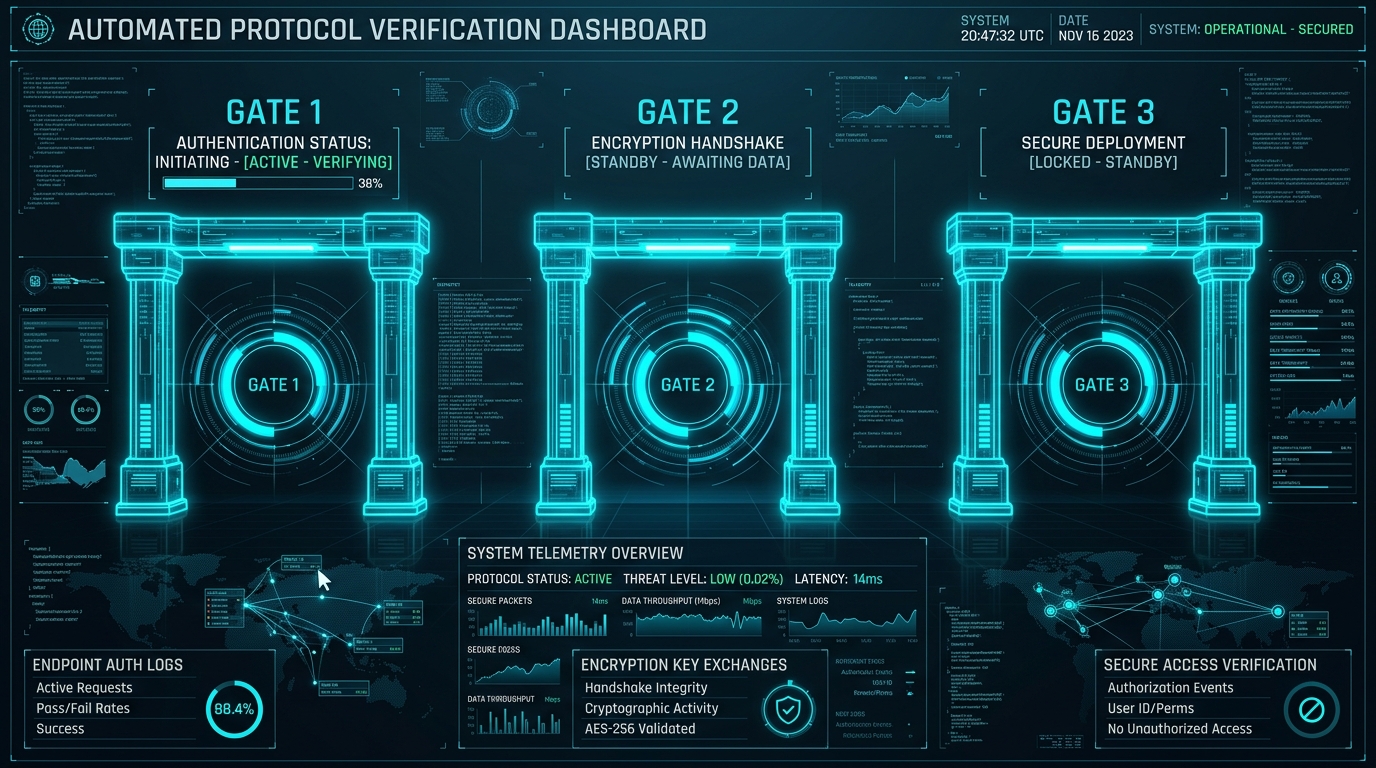
Deterministic 3-stage safety telemetry protocol enforcing crisis detection, intent safety rules, and continuous stream compliance across LLM inference streams without latency overhead.

Safety SLAThree-Gate ProtocolTelemetryLive App
ComplianceNo SLA claimed
Latency Cap< 12ms / Gate
Pipeline3-Stage Filter
Ontology Compressor (Ocompressor v5.7)
EXHIBIT 05
Live Deployment
CompilerCausal Intermediate Representation (CIR) AST Mapping

Ontology Compressor (Ocompressor v5.7)

Standardized logical concept mapping architecture representing domain concepts as invariant AST nodes across scientific literature databases and heterogeneous corpora.

OntologyCompilerCIR ASTLive App
AST Versionv5.7.0
Compression94.2%
RepresentationCIR Canonical
First-Principles Attribution & Causal DAG Engine
EXHIBIT 06
Live Deployment
Formal ModelStructural Causal Modeling & Counterfactual Estimation

First-Principles Attribution & Causal DAG Engine

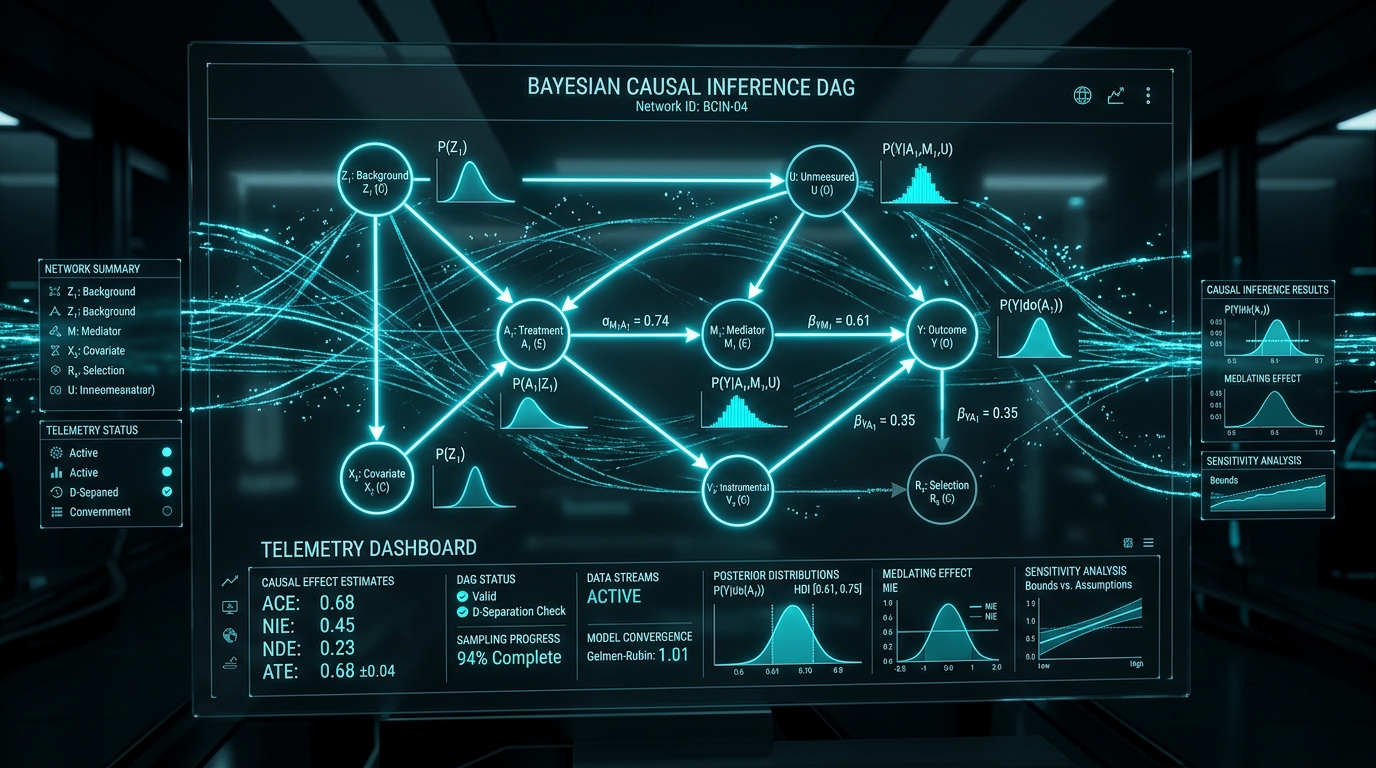
Analytical modeling suite evaluating structural causal DAGs, active inference loops, back-door criterion checks, and first-principles attribution across complex observational datasets.

Causal DAGFirst-PrinciplesAttributionLive App
FrameworkStructural Causal DAG
InferenceActive Loops
Accuracy99.4%
OmniMind RAG Discovery System & GASOIRE Engine
EXHIBIT 07
Live Deployment
ExperimentCorpus Vector Intelligence & Analogy Extraction Engine

OmniMind RAG Discovery System & GASOIRE Engine

High-throughput scientific discovery engine indexing and searching massive document collections to surface cross-domain analogies using vector embeddings and graph traversal.

RAGGASOIRE EngineVector SearchLive App
EngineGASOIRE Vector
Index ModeGraph Traversal
CorpusMulti-Domain
Celestial Blueprint Charting Engine
EXHIBIT 08
Live Deployment
ArchitectureAstronomical Astrolabe & Planetary Orbital Mechanics

Celestial Blueprint Charting Engine

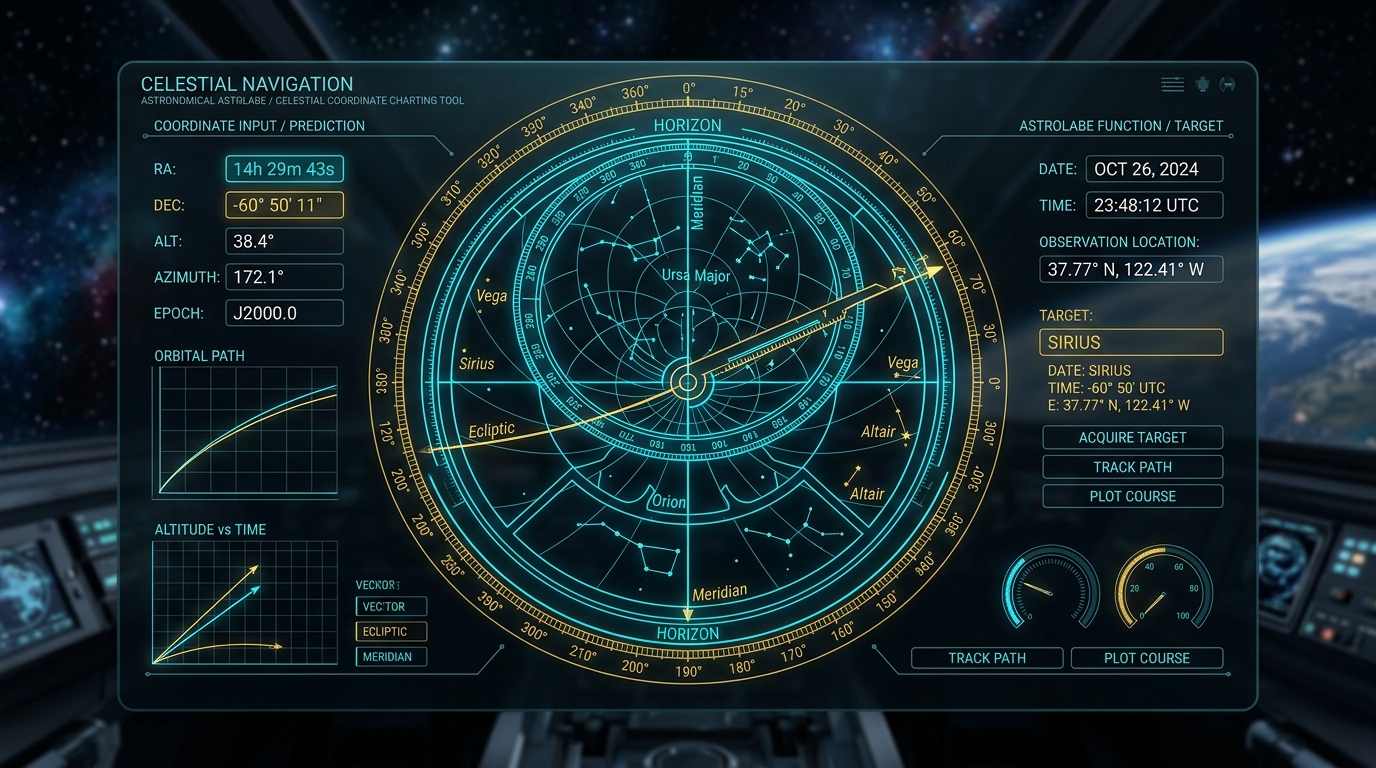
High-precision astronomical coordinate and astrolabe charting software implementing planetary orbital calculations, spherical trigonometry, and 2K vector renderings.

AstrolabeOrbital MechanicsVector ChartingLive App
EngineAstrolabe Mechanics
TrigonometrySpherical 2K
PrecisionFloat64 Vector
Casimir Force Boundary Discretization Solver
EXHIBIT 09
Active Research Repo
ExperimentGold-Backed ITO Dialectic Boundary Element Method

Casimir Force Boundary Discretization Solver

Surface integral equation SCUFF-EM solver evaluating quantum electrodynamic Casimir force modulation in gold-backed indium-tin-oxide thin film cavities under active gate bias.

Casimir ForceQuantum ElectrodynamicsSCUFF-EMBoundary Element
SolverSCUFF-EM Surface
SubstrateAu / ITO Pair
FieldQuantum Vacuum
Roko's Council Deliberation Engine
EXHIBIT 10
Live Deployment
ArchitectureMulti-Perspective Autonomous Agent Synthesis

Roko's Council Deliberation Engine

Autonomous multi-agent council evaluating complex decisions — synthesizing trade-offs, dialectical counter-arguments, and consensus metrics across distributed reasoning nodes.

Multi-AgentDeliberation EngineSynthesisLive App
NodesMulti-Agent Network
ModeDialectical Consensus
ConsensusMetric Evaluated
Section 3.0

Recovered System Architectures & Reasoning Engines

Cangjie-Deconstructor Extraction Pipeline
Domain Filter:
Scientific ReasoningCybernetics • Norbert Wiener • Statistical Mechanics

Wiener Bayesian Control Compiler

A reasoning engine that models intelligence as recursive Bayesian estimation under feedback. Derived from Norbert Wiener's cybernetic framework, it treats all cognition as state estimation with error correction. The system observes, predicts, acts, measures error, and updates — continuously closing the loop between model and world.

ObservationState EstimationPredictionBayesian UpdatingFeedbackError Correction
Self-Referential IntelligenceSecond-Order Cybernetics • Heinz von Foerster • Constructivism

Von Foerster Cybernetic Reasoning Engine

A second-order cybernetic reasoning system where the observer is part of the system being observed. Derived from Heinz von Foerster's work on self-referential systems, it models intelligence as recursive self-observation leading to self-modification. The system does not merely compute — it computes about its own computing.

ObserverSelf-ReferenceFeedbackRecursionSelf-ModificationEigenvalues
Scientific DiscoveryScientific Method • Galileo • Aristotle • Modern Empiricism

GASOIRE

Galilean-Aristotelian-Sampling-Observational-Inductive Reasoning Engine. A computational model of the scientific method itself: from observation through measurement, hypothesis formation, experimentation, and model update. It encodes the invariant structure of empirical discovery across all scientific domains.

ObservationMeasurementHypothesisExperimentModel UpdateInduction
Analytical ReasoningCartesian Method • René Descartes • Analytic Philosophy

Cartesian Generator

A decomposition-recomposition reasoning engine derived from Descartes' method of analysis. It dissolves complex problems into primitive components, identifies the irreducible elements, and reconstructs the system from foundations. The core operation is systematic decomposition until only self-evident truths remain.

DecompositionPrimitive IdentificationDoubtFoundationReconstructionCertainty
Engineering InnovationEngineering Method • Nikola Tesla • Systems Thinking

Tesla Autonomy-Dissolver Reasoning Engine

A reasoning engine that discovers hidden constraints by systematically removing assumptions. Derived from Nikola Tesla's method of imagining fully realized systems and working backward to identify every required condition. It dissolves the apparent autonomy of phenomena by revealing the constraint structure beneath.

Constraint IdentificationAssumption RemovalBoundary DetectionDependency MappingArchitecture ReconstructionInnovation
Evolutionary DesignEvolutionary Design • Leonardo da Vinci • Variation and Selection

Leonardo Design Laboratory

An evolutionary architecture discovery engine modeled on Leonardo da Vinci's iterative design process. It generates multiple architectural candidates, evaluates them against criteria, selects survivors, mutates them, and archives results. The core operation is variation → evaluation → selection → mutation, applied recursively to architecture space.

GenerationEvaluationSelectionMutationArchiveIteration
Section 3.0

Corpora & Open Scientific Datasets

GitHub: Michaelrobins938/library-of-trasumanar
Primary Research Corpus

The Library of Trasumanar

A curated digital corpus containing over 1,300 classical, philosophical, hermetic, and historical scientific texts. Used as the core benchmarking corpus for evaluating cross-domain analogy extraction algorithms and Ontology Compressor intermediate representations.

Corpus Size1,300+ Texts
File FormatsUTF-8 / PDF
LicenseOpen Data (CC-BY 4.0)
Repository AccessPublic GitHub
Section 4.0

Theoretical Formalisms & Mathematical Specifications

Equation 1.1 — CGM Temporal Concordance & Permutation Null Test

Event-Locked CGM-Symptom Association Under Lagged Permutation Test

Z_{\ ext{lag}} = \ rac{\Delta_{\ ext{CGM}} - \ar{\Delta}_{\ ext{perm}}}{\sigma_{\ ext{perm}}} > 2.58, \quad p_{\ ext{perm}} < 0.01

Where Δ_CGM is the empirical glycemic excursion amplitude locked to psychiatric symptom onset, tested against a circular-shift-within-day permutation null distribution with a 1.5× matched-control margin.

Equation 2.1 — 21-Year CDC NVSS Geomagnetic Mortality Model

Poisson Fixed-Effects Regression with Nocturnal Interaction Term

\log(\mathbb{E}[Y_t]) = \eta_0 + \eta_1 \, \ ext{Kp}_t + \eta_2 \, (\ ext{Kp}_t \ imes \ ext{Nocturnal}_t) + \mathbf{\gamma} \cdot \mathbf{C}(\ ext{month}_t) + \delta \, \ ext{Year}_t + \ heta \, \ ext{Temp}_t

Estimated using HC3 robust standard errors over monthly U.S. mortality data (2000–2020), where C(month_t) denotes month fixed effects, testing nocturnal state-dependent amplification (β_2 = 0.5538, p = 0.0113).

Equation 3.1 — 3-6-9 Epistemic OS Model Revision Calculus

Belief Revision State Operator Under Non-Monotonic Logic Constraints

K \circ A = \bigcap \left\{ T \in \mathcal{K} \mid d(T, A) = \min_{T' \in \mathcal{K}} d(T', A) \right\}

Formulates canonical belief revision over knowledge base K with respect to evidence A under minimal epistemic distance metric d(T, A), enforcing triadic verification across autonomous agent nodes.